Stovetop Cleaning
Real-world · Long-horizonWCM trained on 125 real-world stovetop cleaning episodes.
Real-world and simulation rollouts evaluated by the World Critic Model.
WCM trained on 125 real-world stovetop cleaning episodes.
WCM trained on 100 real-world cloth folding episodes.
WCM trained on 181 real-world pick-and-place episodes.
WCM trained on 64848 collected ManiSkill trajectories.
WCM trained on official LIBERO-Plus dataset trajectories.
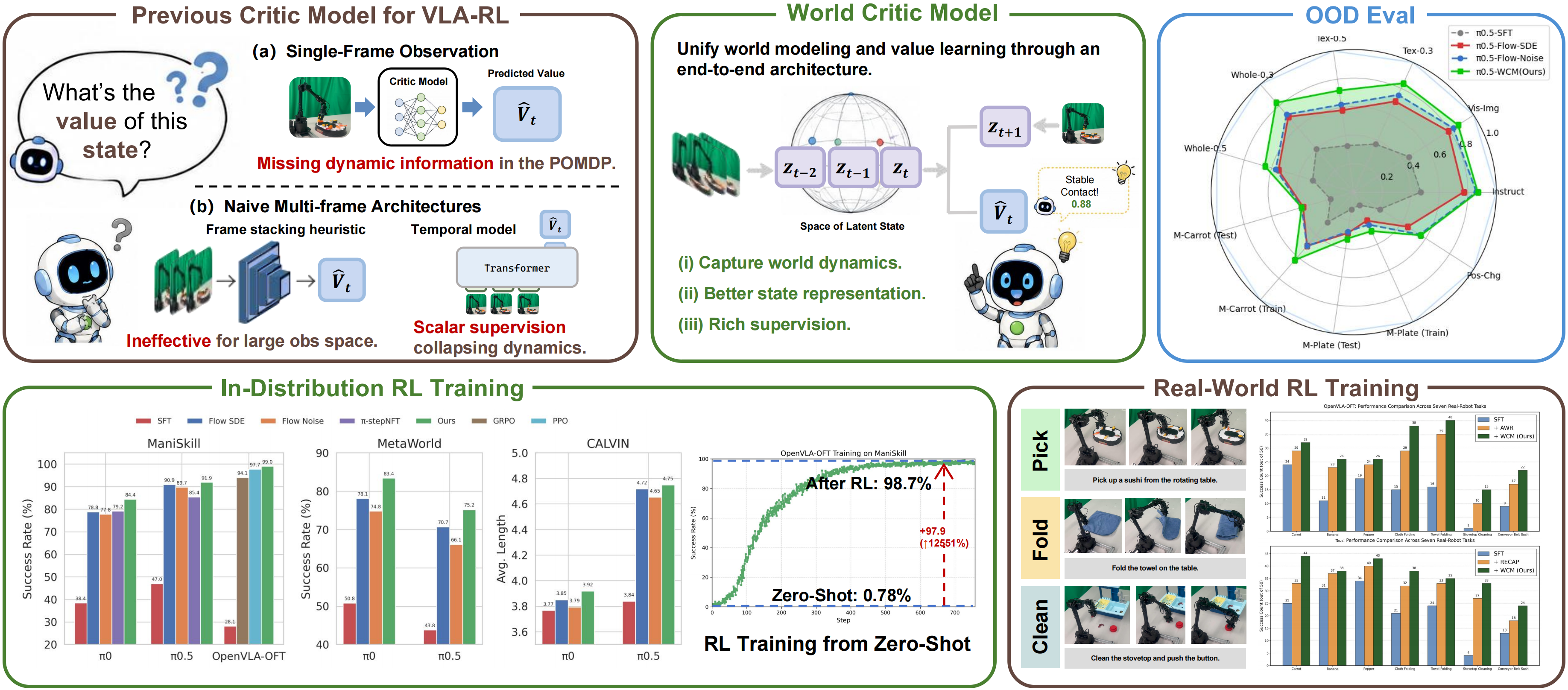
Reinforcement learning (RL) post-training of Vision-Language-Action (VLA) models has shown strong promise for robotic manipulation. Among RL methods, critic-based approaches rely on a value estimator that predominantly operates on single-frame observations or single-frame VLM backbone latents, which is a fundamental mismatch with the partially observable nature of robot control. A naïve approach to incorporate observation history into the critic incurs exponential complexity with high-dimensional visual space, and still fails because pure scalar-return regression provides insufficient supervision for learning cross-temporal dynamics. We identify the root cause as a state approximation problem: without an explicit world modeling objective, the critic’s representation cannot capture the temporal structure needed for accurate value estimation.
To address this, we propose the World Critic Model (WCM), built on a lightweight LeJEPA architecture. WCM jointly predicts future latent state and estimates values, such that the critic’s representation is explicitly trained to capture temporal dynamics rather than merely regress scalar returns. WCM integrates seamlessly into both on-policy and off-policy training pipelines and is compatible with state-of-the-art VLA backbones. Extensive experiments on 149 tasks across four benchmarks demonstrate that WCM consistently achieves state-of-the-art performance in both in-distribution and out-of-distribution settings, with particularly strong generalization gains. We further validate WCM on seven real-world manipulation tasks with off-policy RL, confirming stable deployment across diverse settings.
A predictive critic that learns temporal state representations through joint world prediction and value estimation.
We model robotic manipulation with VLA models as a partially observable Markov decision process (POMDP). At each timestep, the observation only partially reveals the latent system state; a critic must therefore recover temporally informative state from observation history and task context.
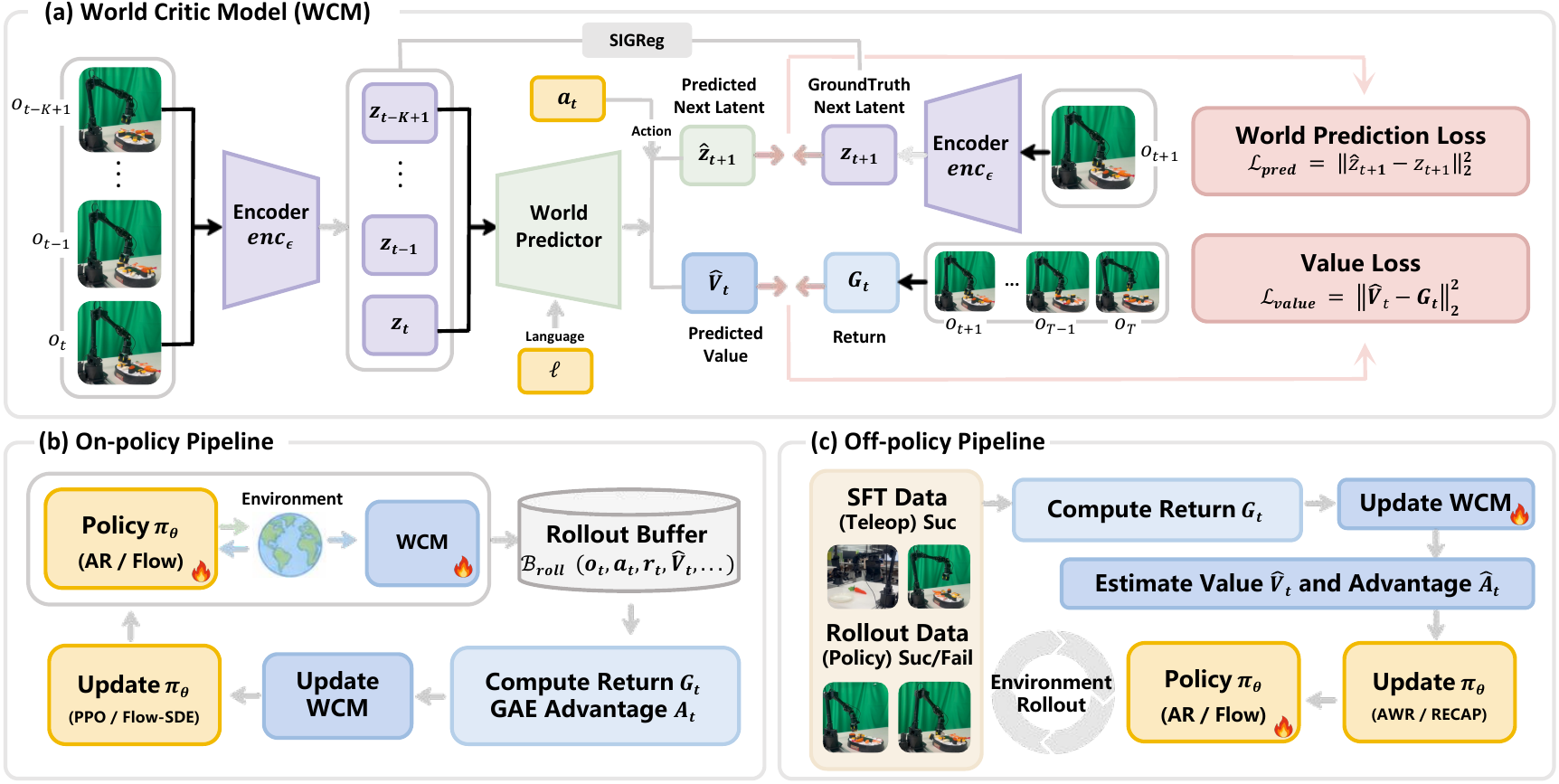
Given observations from \(t-K+1\) to \(t\), the observation encoder processes every frame independently. The language instruction is encoded by CLIP and mapped into the WCM latent space by a learned adapter. The visual history first attends to the instruction token, after which a causal Transformer history trunk produces the shared temporal representation \(\mathbf h_t\).
Two decoder heads operate on the shared representation. The value head estimates the return from \(\mathbf h_t\), while the action-conditioned dynamics head predicts the next visual latent through a residual update anchored at the current latent state \(\mathbf z_t\).
WCM is trained with next-latent prediction, value supervision, and Sketched-Isotropic Gaussian Regularization (SIGReg). The return is min-max normalized to \([-1,1]\) before value regression. All components are optimized jointly.
Here \(\mathbf a\) is a random unit vector sampled uniformly from the \((d-1)\)-sphere, \(\phi(t)=e^{-t^2/2}\) is the characteristic function of a standard normal, and \(\hat\phi_{\mathbf a^\top\mathbf z}(t)=\mathbb E_{\mathbf z}[e^{it(\mathbf a^\top\mathbf z)}]\) is estimated over a mini-batch. Matching random one-dimensional projections to a standard Gaussian prevents dimensional collapse and mode degeneration in the latent space.
WCM replaces the original critic. Values from on-policy rollouts are used to compute GAE advantages, after which the policy is updated with PPO or its flow-matching variant, Flow-SDE.
Teleoperated SFT data and policy rollouts, including failure cases, share one buffer. WCM estimates returns and advantages before policy updates with AWR or RECAP.
Evaluation across ManiSkill, MetaWorld, CALVIN, LIBERO-Plus, and seven real-world manipulation tasks.
We evaluate 149 tasks across four benchmarks. ManiSkill measures in-distribution performance and OOD generalization along vision, semantic, and execution axes; MetaWorld covers manipulation beyond pick-and-place; CALVIN evaluates long-horizon capabilities; and LIBERO-Plus evaluates generalization under seven types of perturbations.
We evaluate seven tasks on WidowX-250S: one dynamic grasping task, one long-horizon task, two deformable-object tasks, and three pick-and-place tasks. For sample efficiency, the real-robot experiments use the off-policy WCM pipeline.
WCM achieves state-of-the-art performance across ManiSkill, MetaWorld, and CALVIN. On ManiSkill, it substantially improves policies initialized from weak SFT checkpoints and remains effective even from an initialization with no exposure to ManiSkill data. The gains extend beyond pick-and-place to contact-rich MetaWorld tasks and long-horizon CALVIN sequences.
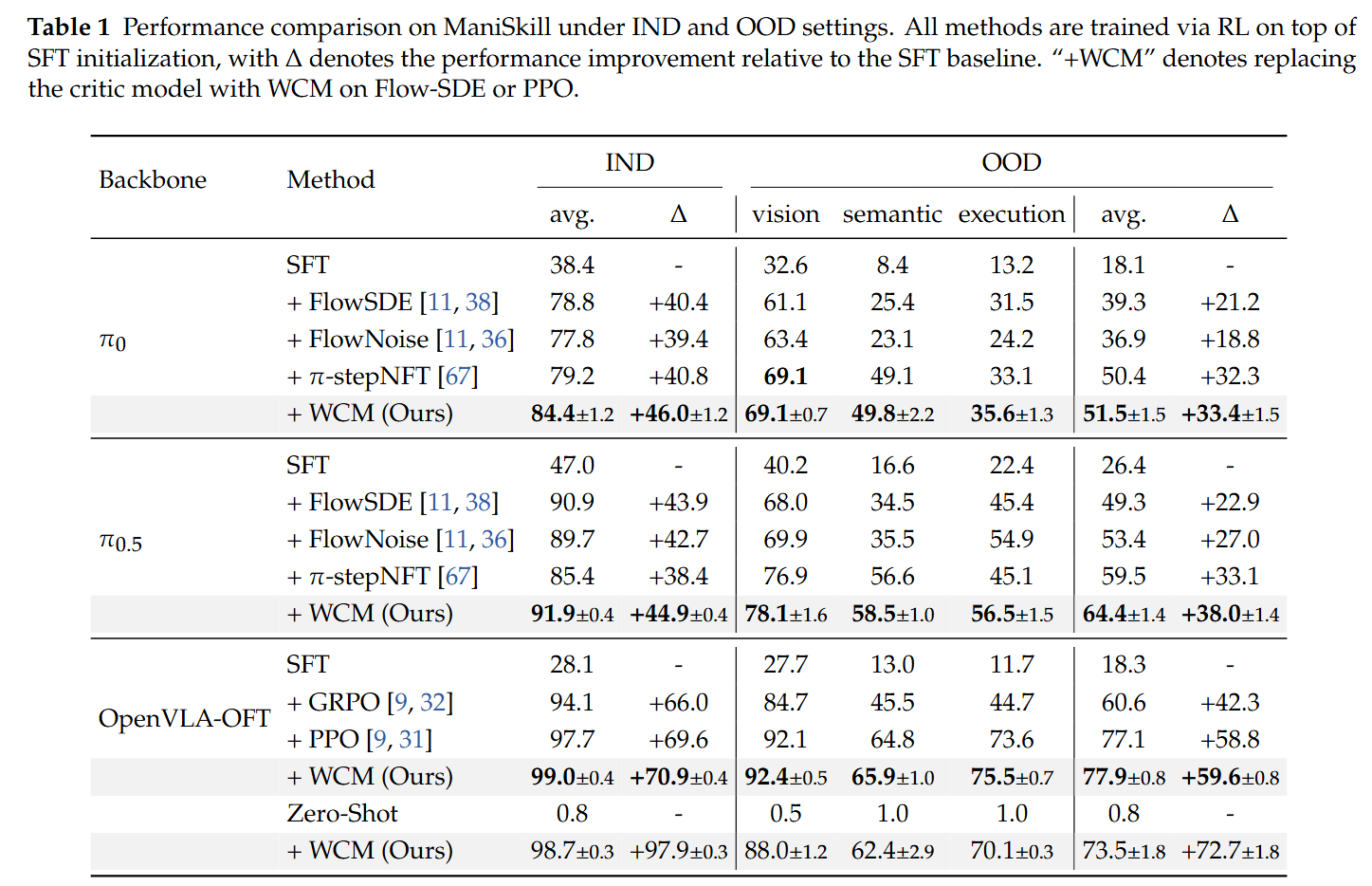
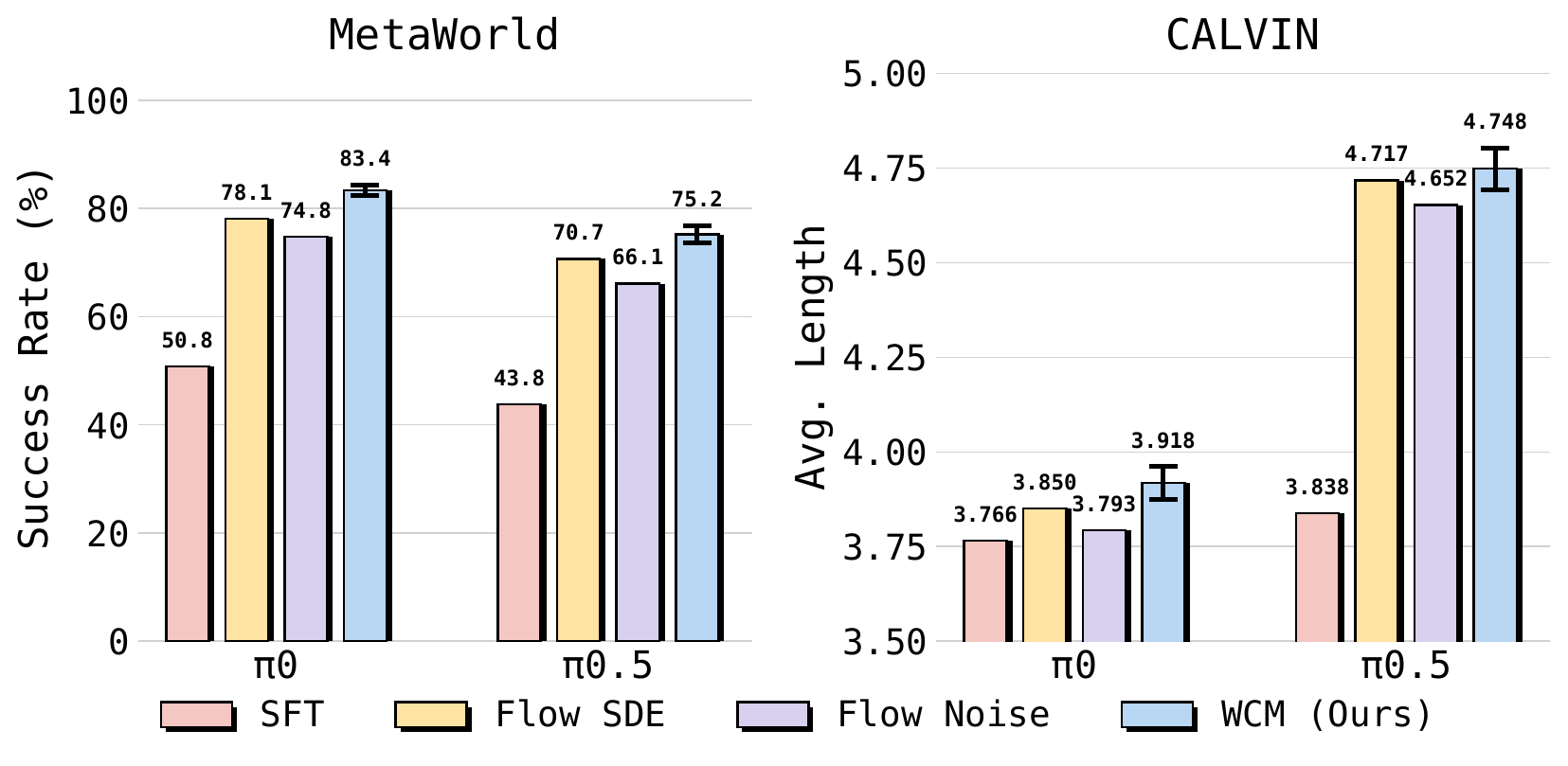
On ManiSkill, WCM improves both IND performance and OOD generalization, outperforming the corresponding Flow-SDE and PPO critics as well as a baseline known for strong OOD performance. In LIBERO-Plus, starting from one-shot SFT, WCM surpasses full-shot SFT trained on 20k trajectories after about 250 RL training steps.
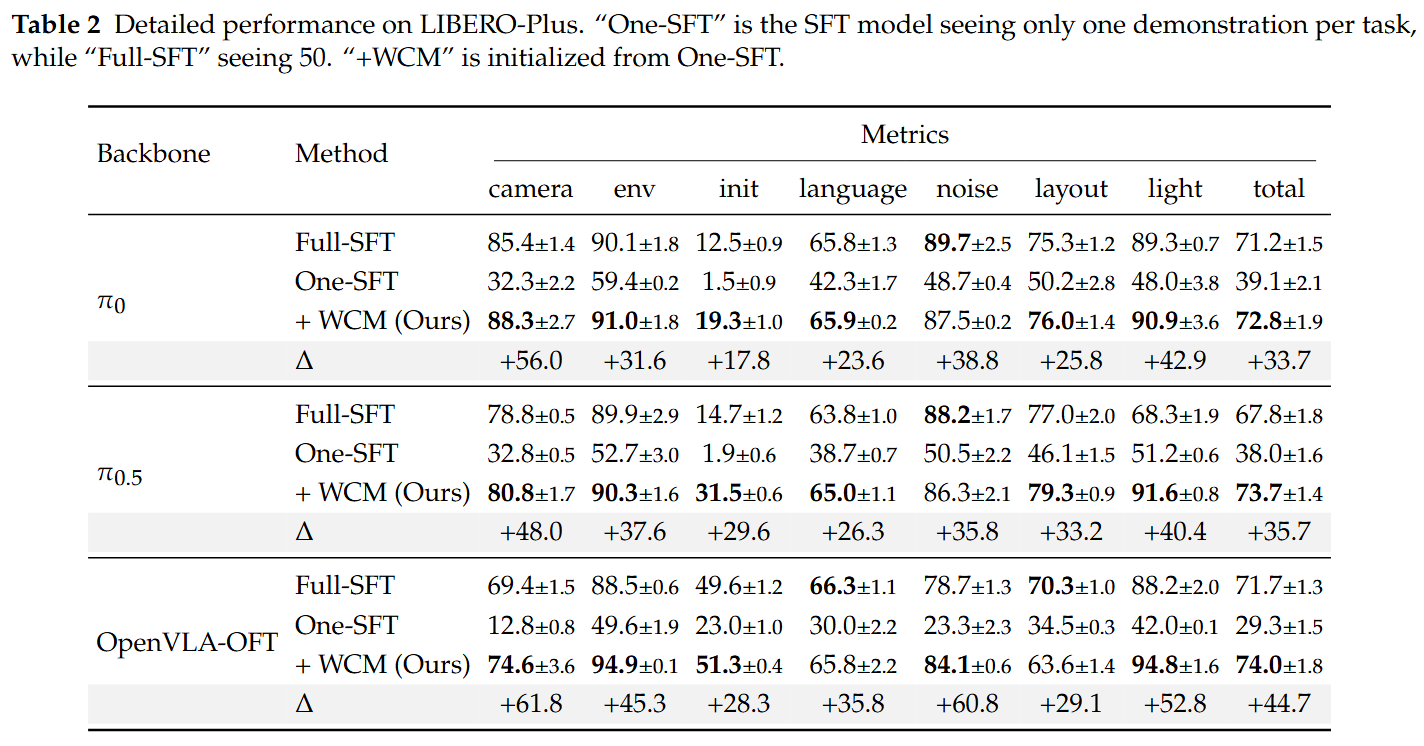
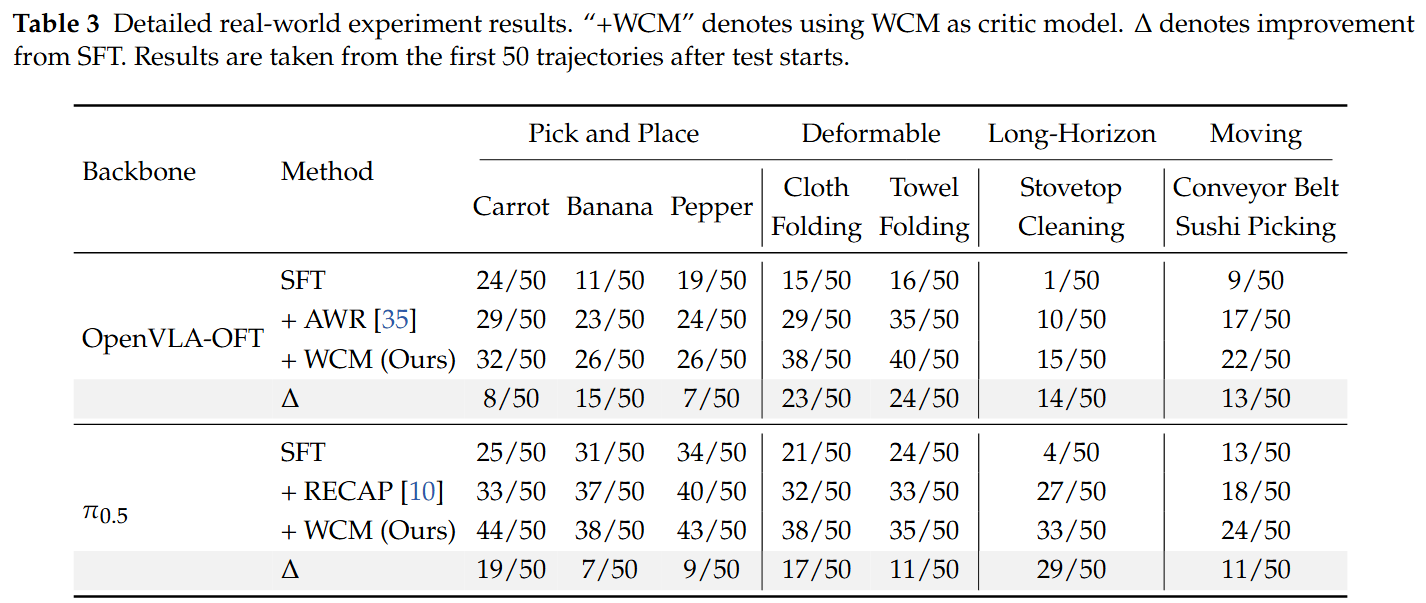
The real-world study uses the off-policy pipeline for sample efficiency. We evaluate dynamic manipulation (rotating sushi picking), deformable-object manipulation (cloth and towel folding), long-horizon manipulation (stovetop cleaning), and three pick-and-place tasks. WCM outperforms the corresponding off-policy baselines across all seven tasks.
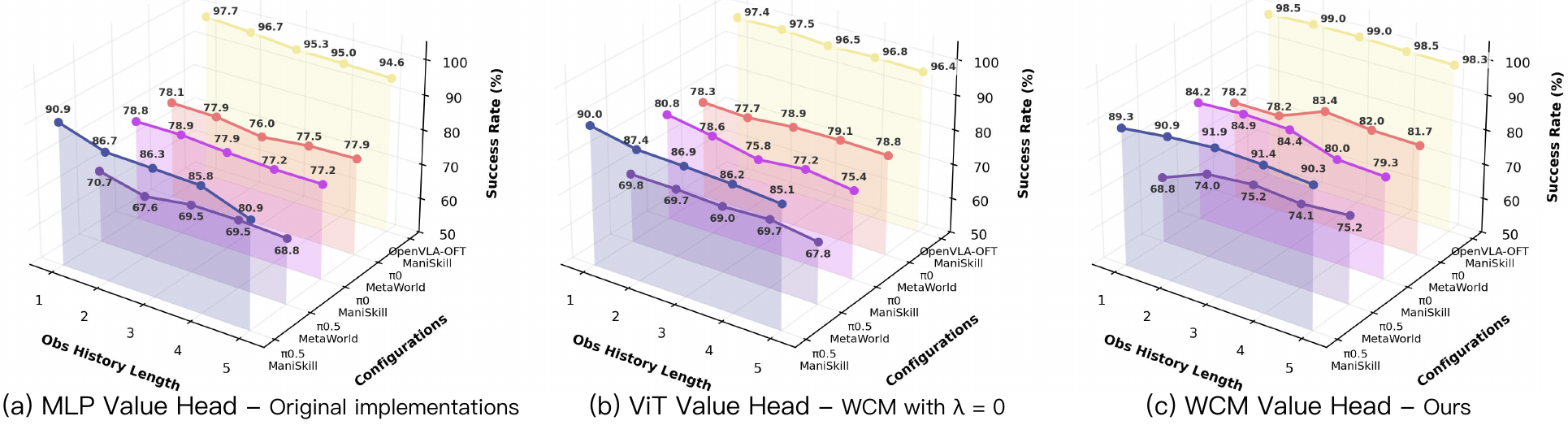
Merely extending the original critic from a single frame to a longer observation history can remain suboptimal. A history-based ViT without world prediction, corresponding to \(\lambda=0\), is also insufficient. Joint next-latent prediction and value learning yields the strongest performance; among the evaluated history lengths, three frames perform best on average.
Additional analysis
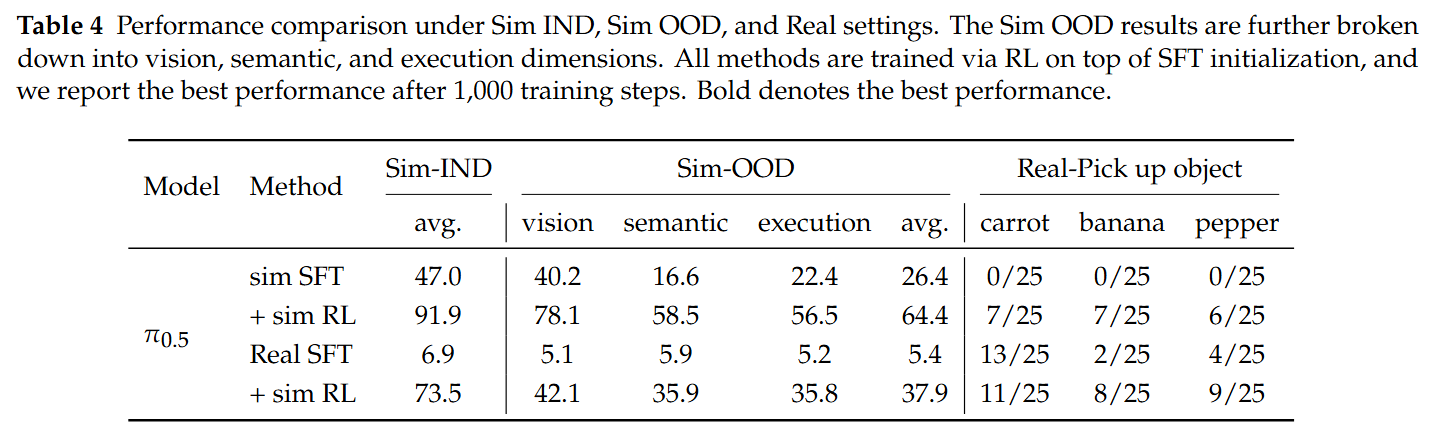
The appendix compares simulated SFT, simulated RL, and real-data initialization under simulation IND, simulation OOD, and real pick-and-place evaluation. Simulation RL improves direct real-world transfer over simulation SFT, while the remaining cross-domain gap highlights the asymmetry between simulated and real data.
@article{fei2026wcm,
  title={WCM: A World Critic Model for Vision-Language-Action Reinforcement Learning},
  author={Fei, Senyu and Yu, Xiaopeng and Wang, Siyin and Zhao, Xianzhong and Gong, Jingjing and Qiu, Xipeng},
  journal={arXiv preprint arXiv:2607.29613},
  year={2026}
}